On behalf of the Nominating Committee, I’m pleased to share the slate of candidates for the 2026 board election. Every active member organisation is invited to submit a ballot to elect the incoming board class.
We’re providing a summary of the board’s July 2026 meeting. The July board meeting is our only in-person meeting. The board gathers for two days of strategic thinking and long-range planning, as well as conducting annual board business. This year, we focused on allocating surplus funds we have on hand to invest in a three-year project to redesign the content system. In a related discussion, we decided to lower content registration fees starting in 2027 because we’ve had a demonstrated history of generating surpluses, exceeding what we need to run Crossref. We also discussed the board structure, as part of our regular review of stakeholder governance. And we conducted annual board business, such as approving the audited financial statements and reviewed our risk register and mitigation plans.
The resolutions are available on the dedicated section of our website, which also lists the members of the Board and offers further information about our governance.
We also managed to squeeze in watching a World Cup game over dinner.
Starting today, funder names deposited in Crossref metadata without an identifier will be matched to ROR IDs, to support an open and connected Research Nexus. Funding information is an increasingly important part of the scholarly record. The improved matching strategy supports researchers, funders, institutions, and meta-researchers, who rely on that information to understand how research is supported and what outcomes that support produces.
Strengthening Scholarly Publishing in Africa is a collaborative webinar series bringing together ASSAf, Crossref, DOAJ, EIFL, and PKP to share practical guidance, resources, and approaches for strengthening the publishing ecosystem in the region. This series responds to the growing interest in open access, digital publishing, stronger editorial practices, and greater visibility of research publishing across Africa. Each partner organisation has long experience of building that capacity in the area of their expertise. In this series, we’re coming together to offer a more holistic learning experience to the community of African publishers, putting different aspects of the publishing process in their broader context.
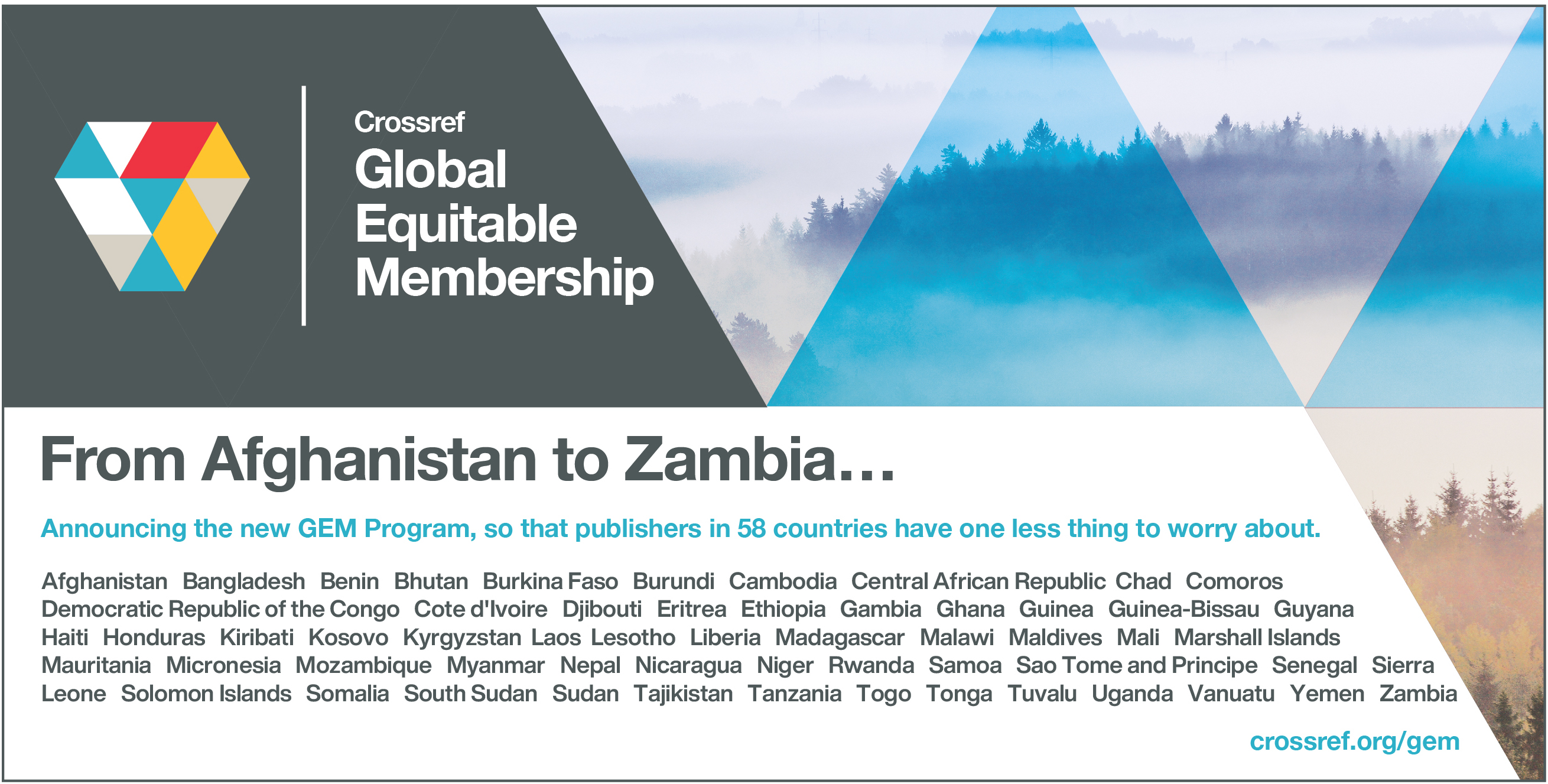
When Crossref began over 20 years ago, our members were primarily from the United States and Western Europe, but for several years our membership has been more global and diverse, growing to almost 18,000 organisations around the world, representing 148 countries.
As we continue to grow, finding ways to help organisations participate in Crossref is an important part of our mission and approach. Our goal of creating the Research Nexus—a rich and reusable open network of relationships connecting research organisations, people, things, and actions; a scholarly record that the global community can build on forever, for the benefit of society—can only be achieved by ensuring that participation in Crossref is accessible to all. Building a network for the global community must include input from all of the global community.
In August 2022, the United States Office of Science and Technology Policy (OSTP) issued a memo (PDF) on ensuring free, immediate, and equitable access to federally funded research (a.k.a. the “Nelson memo”). Crossref is particularly interested in and relevant for the areas of this guidance that cover metadata and persistent identifiers—and the infrastructure and services that make them useful.
Funding bodies worldwide are increasingly involved in research infrastructure for dissemination and discovery. While this post does respond to the OSTP guidelines point-by-point, the information here applies to all funding bodies in all countries. It will be equally useful for publishers and other systems that operate in the scholarly research ecosystem.
Preprints have become an important tool for rapidly communicating and iterating on research outputs. There is now a range of preprint servers, some subject-specific, some based on a particular geographical area, and others linked to publishers or individual journals in addition to generalist platforms. In 2016 the Crossref schema started to support preprints and since then the number of metadata records has grown to around 16,000 new preprint DOIs per month.
One of the things that makes me glad to work at Crossref is the principles to which we hold ourselves, and the most public and measurable of those must be the Principles of Open Scholarly Infrastructure, or POSI, for short. These ambitions lay out how we want to operate - to be open in our governance, in our membership and also in our source code and data. And it’s that openness of source code that’s the reason for my post today - on 26th September 2022, our first collaboration with the JSON Forms open-source project was released into the wild.
Ans: metadata and services are all underpinned by POSI.
Leading into a blog post with a question always makes my brain jump ahead to answer that question with the simplest answer possible. I was a nightmare English Literature student. ‘Was Macbeth purely a villain?’ ‘No’. *leaves exam*
In part one of our series on the Integrity of the Scholarly Record (ISR), we talked about how the metadata that our members register with us helps to preserve the integrity of the record, and in particular how ’trust signals’ in the metadata, combined with relationships and context, can help the community assess the work.
In this second blog, we describe membership eligibility and what you can and cannot tell simply from the fact that an organisation is a Crossref member; why increasing participation and reducing barriers actually helps to enhance the integrity of the scholarly record; and how we handle the very small number of cases where there may be a question mark.
The integrity of the scholarly record is an essential aspect of research integrity. Every initiative and service that we have launched since our founding has been focused on documenting and clarifying the scholarly record in an open, machine-actionable and scalable form. All of this has been done to make it easier for the community to assess the trustworthiness of scholarly outputs. Now that the scholarly record itself has evolved beyond the published outputs at the end of the research process – to include both the elements of that process and its aftermath – preserving its integrity poses new challenges that we strive to meet… we are reaching out to the community to help inform these efforts.
I’m pleased to share the 2022 board election slate. Crossref’s Nominating Committee received 40 submissions from members worldwide to fill five open board seats.
We maintain a balance of eight large member seats and eight small member seats. A member’s size is determined based on the membership fee tier they pay. We look at how our total revenue is generated across the membership tiers and split it down the middle. Like last year, about half of our revenue came from members in the tiers $0 - $1,650, and the other half came from members in tiers $3,900 - $50,000. We have four large member seats and one small member seat open for election in 2022.
Our entire community – members, metadata users, service providers, community organisations and researchers – create and/or use DOIs in some way so making them more accessible is a worthy and overdue effort.
For the first time in five years and only the second time ever, we are recommending some changes to our DOI display guidelines (the changes aren’t really for display but more on that below). We don’t take such changes lightly, because we know it means updating established workflows. We appreciate the questions that prompted us to make this recommendation and we know it’s critical that we get community input on the proposed updates.
I’m delighted to say that Martin Paul Eve will be joining Crossref as a Principal R&D Developer starting in January 2023.
As a Professor of Literature, Technology, and Publishing at Birkbeck, University of London- Martin has always worked on issues relating to metadata and scholarly infrastructure. In joining the Crossref R&D group, Martin can focus full-time on helping us design and build a new generation of services and tools to help the research community navigate and make sense of the scholarly record.