On behalf of the Nominating Committee, I’m pleased to share the slate of candidates for the 2026 board election. Every active member organisation is invited to submit a ballot to elect the incoming board class.
We’re providing a summary of the board’s July 2026 meeting. The July board meeting is our only in-person meeting. The board gathers for two days of strategic thinking and long-range planning, as well as conducting annual board business. This year, we focused on allocating surplus funds we have on hand to invest in a three-year project to redesign the content system. In a related discussion, we decided to lower content registration fees starting in 2027 because we’ve had a demonstrated history of generating surpluses, exceeding what we need to run Crossref. We also discussed the board structure, as part of our regular review of stakeholder governance. And we conducted annual board business, such as approving the audited financial statements and reviewed our risk register and mitigation plans.
The resolutions are available on the dedicated section of our website, which also lists the members of the Board and offers further information about our governance.
We also managed to squeeze in watching a World Cup game over dinner.
Starting today, funder names deposited in Crossref metadata without an identifier will be matched to ROR IDs, to support an open and connected Research Nexus. Funding information is an increasingly important part of the scholarly record. The improved matching strategy supports researchers, funders, institutions, and meta-researchers, who rely on that information to understand how research is supported and what outcomes that support produces.
Strengthening Scholarly Publishing in Africa is a collaborative webinar series bringing together ASSAf, Crossref, DOAJ, EIFL, and PKP to share practical guidance, resources, and approaches for strengthening the publishing ecosystem in the region. This series responds to the growing interest in open access, digital publishing, stronger editorial practices, and greater visibility of research publishing across Africa. Each partner organisation has long experience of building that capacity in the area of their expertise. In this series, we’re coming together to offer a more holistic learning experience to the community of African publishers, putting different aspects of the publishing process in their broader context.
Wednesday 22nd October 2025—Crossref, the open scholarly infrastructure nonprofit, today releases an enhanced dashboard showing metadata coverage and individual organisations’ contributions to documenting the process and outputs of scientific research in the open. The tool helps research-performing, funding, and publishing organisations identify gaps in open research information, and provides supporting evidence for movements like the Barcelona Declaration for Open Research Information, which encourages more substantial commitment to stewarding and enriching the scholarly record through open metadata.
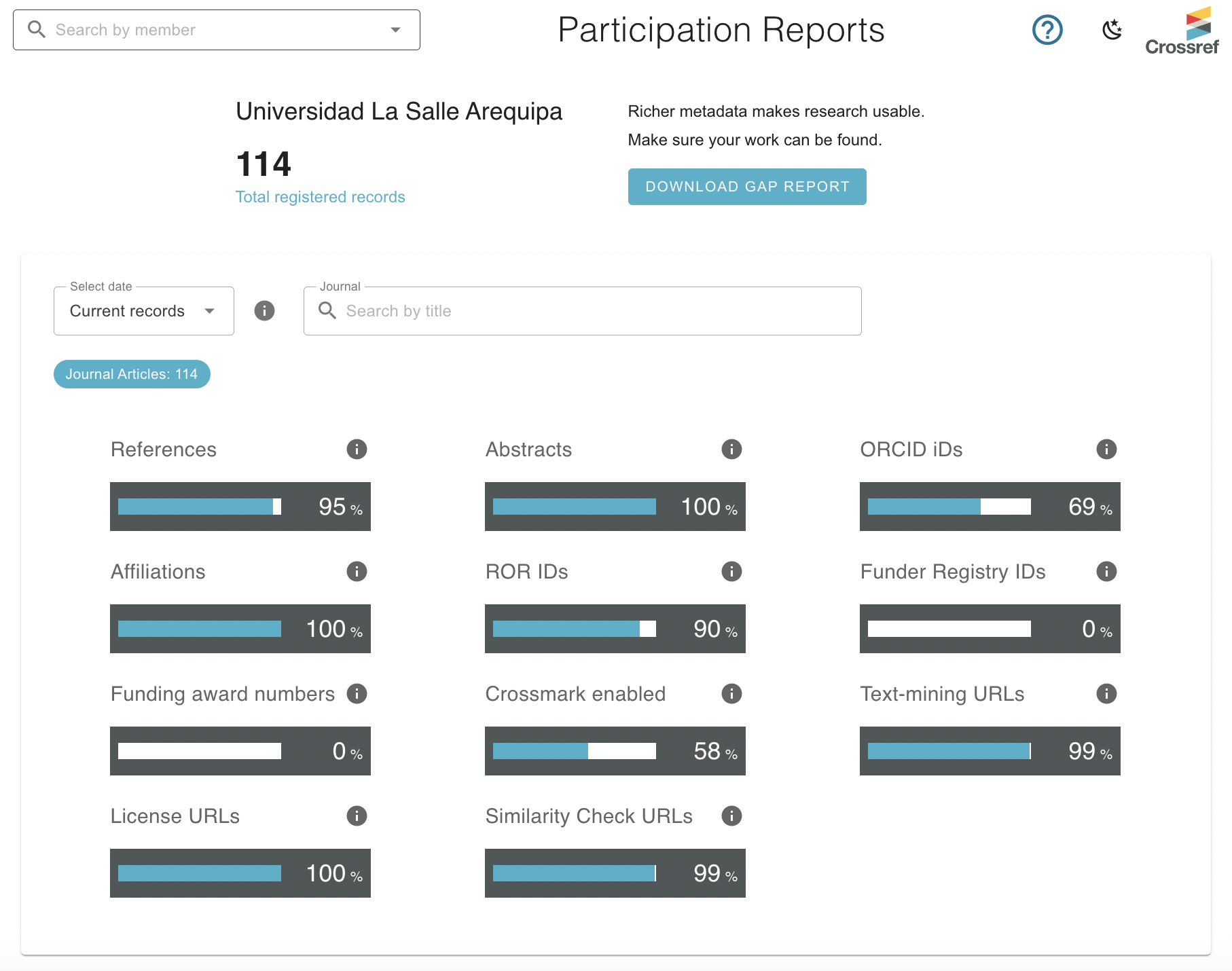
Crossref’s Participation Reports now offer expanded features and provide full coverage of all members and all resource types registered with Crossref DOIs (Digital Object Identifiers)—over 175 million records representing a significant share of global research production from organisations in 164 countries. Each of Crossref’s 23,000 members has a dashboard to visualise their metadata contributions, display coverage of key information for scholarly works, and get actionable feedback via a gap report that specifies records that need enrichment, all helping to make more transparent the work that goes into creating and curating the scholarly record.
For any Crossref member—whether journal publisher, research funder, university, or museum—coverage of up to 11 key elements is public and visible to everyone, including: references, abstracts, ORCID iDs, affiliation strings, ROR IDs, Open Funder Registry IDs, funding award numbers, text-mining URLs, licence URLs, Similarity Check URLs (for text-based plagiarism checking) and the presence of a Crossmark policy, indicating the organisation’s commitment to declare corrections and retractions. These metadata elements provide greater context and visibility for research objects such as journal articles and preprints, grants and awards, books and book chapters, standards, datasets, conference papers and various ‘other’ content such as scholarly blogs, images, and even physical museum artefacts.
Mochammad Tanzil Multazam, Library Director of Universitas Muhammadiyah Sidoarjo, and Secretary of the Supervisory Board of Relawan Jurnals, says, “As a sponsoring organisation for several thousand small publishers across Indonesia, we support Crossref members to register complete metadata for their works. Despite time and resource constraints, this new actionable open report on key metadata elements will help drive improvements in the information they share for their publications. This has wide-reaching implications for the visibility of that research and trust among the community, and therefore has the potential to support Indonesian scholarship in the global context.”
Lena Stoll, Program Lead at Crossref, explains, “We are happy to have extended participation reports to cover more diverse record types, including grants, datasets, dissertations, and more, and to make it easier for our members to act on their ongoing improvements to enrich their records and build towards the vision of an open and more complete Research Nexus.”
Ludo Waltman, Scientific Director and Professor of Quantitative Science Studies at the Centre for Science and Technology Studies (CWTS) at Leiden University, comments, “As a representative of the researcher and metascience communities, this data is of great importance for us to analyse the trends and effects of global research activity. Crossref is one of the main driving forces in open infrastructure, and its commitment to supporting metadata completeness through this open reporting dashboard is a significant step for the open research information movement.”
Access Crossref Participation Reports and search for any Crossref member organisation.
Participation report for a typical Crossref member, Universidad La Salle Arequipa in Peru
About Crossref
Crossref runs an open infrastructure to link research objects, entities, and actions, creating a lasting and reusable scholarly record that underpins open science. Together with their 23,000 members in 164 countries, Crossref drives metadata exchange and supports nearly 2 billion monthly API queries, facilitating global research communication, for the benefit of society.