On behalf of the Nominating Committee, I’m pleased to share the slate of candidates for the 2026 board election. Every active member organisation is invited to submit a ballot to elect the incoming board class.
We’re providing a summary of the board’s July 2026 meeting. The July board meeting is our only in-person meeting. The board gathers for two days of strategic thinking and long-range planning, as well as conducting annual board business. This year, we focused on allocating surplus funds we have on hand to invest in a three-year project to redesign the content system. In a related discussion, we decided to lower content registration fees starting in 2027 because we’ve had a demonstrated history of generating surpluses, exceeding what we need to run Crossref. We also discussed the board structure, as part of our regular review of stakeholder governance. And we conducted annual board business, such as approving the audited financial statements and reviewed our risk register and mitigation plans.
The resolutions are available on the dedicated section of our website, which also lists the members of the Board and offers further information about our governance.
We also managed to squeeze in watching a World Cup game over dinner.
Starting today, funder names deposited in Crossref metadata without an identifier will be matched to ROR IDs, to support an open and connected Research Nexus. Funding information is an increasingly important part of the scholarly record. The improved matching strategy supports researchers, funders, institutions, and meta-researchers, who rely on that information to understand how research is supported and what outcomes that support produces.
Strengthening Scholarly Publishing in Africa is a collaborative webinar series bringing together ASSAf, Crossref, DOAJ, EIFL, and PKP to share practical guidance, resources, and approaches for strengthening the publishing ecosystem in the region. This series responds to the growing interest in open access, digital publishing, stronger editorial practices, and greater visibility of research publishing across Africa. Each partner organisation has long experience of building that capacity in the area of their expertise. In this series, we’re coming together to offer a more holistic learning experience to the community of African publishers, putting different aspects of the publishing process in their broader context.
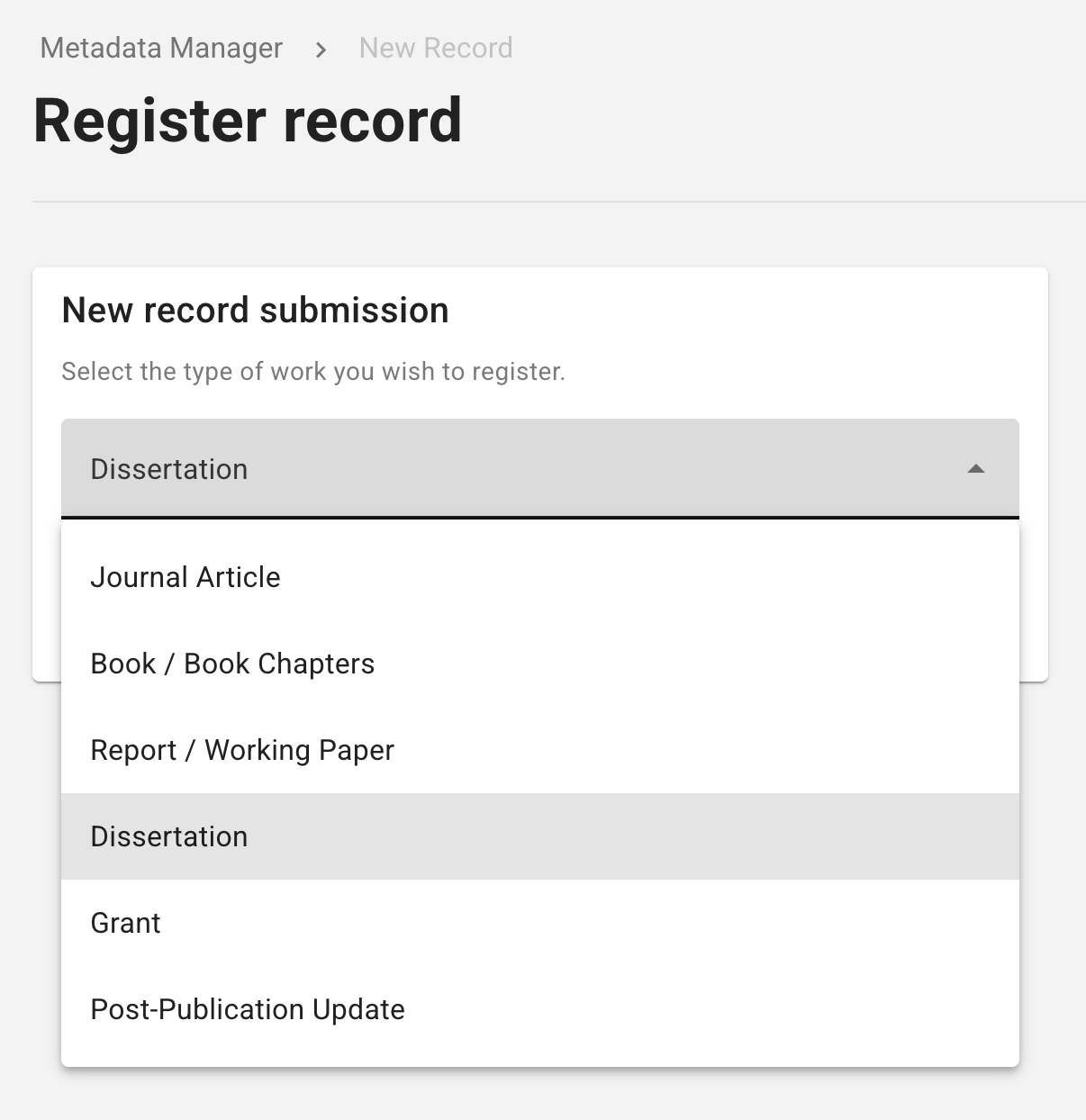
You can now register rich metadata for a variety of record types in Metadata Manager using simple, guided workflows. The tool is used by many in our community to register grant and journal article records, and it has now been expanded to support books and chapters, reports, dissertations, and post-publication updates for journal content.
Metadata Manager makes it easier to capture identifiers for contributors and their affiliations, funding information, references, and more. Thanks to automated reference matching by Crossref, this offers greater visibility for the works, while the affiliations and funding information can serve as important trust signals for the community.
While all these record types have long been supported through our web deposit form, updated Metadata Manager simplifies the workflow, reduces complexity, and enables metadata updates for registered records. This gives our members the option to register these records along with rich metadata efficiently, without needing to work directly with XML files. We encourage existing web deposit form users to switch to Metadata Manager and the good news is that they can use their existing Crossref credentials to log in.
This is the latest step in expanding Metadata Manager to support more of the record types our members register daily. We retired the legacy Metadata Manager at the end of 2025 partly because it could not be extended to support other record types besides journal content. In contrast, we built the new Metadata Manager in a schema-driven way which makes it adaptable to all parts of our input schema, as well as any future schema changes.
And registering a DOI record doesn’t have to be the end of the story. Metadata Manager makes it easier to manage metadata after registration, allowing members to edit existing metadata directly in the helper tool—without having to re-enter the full record. Updating your records is free, and this new editability makes stewarding your metadata simpler.
In this update, our team focused on the record types members use most often. Our goal was to make DOI registration easier and more accessible.
We are currently working on adding support for registering conference proceedings and conference paper records in Metadata Manager; you can expect to see this next update in the coming weeks.
Why this update matters
Making it easier to register books and chapters, reports and working papers, dissertations, and other research outputs helps ensure more of the scholarly record is described with rich metadata. Better metadata strengthens the links between research outputs, contributors, organisations, grants, and other research objects, supporting the Research Nexus and making scholarly information easier to discover, cite, connect, and reuse. And given the importance of clarity about post-publication updates, such as corrections and retractions, for the integrity of the scholarly record, the Metadata Manager will better support our members to adopt industry best practices that enable self-correcting mechanisms in research.
The new functionality is available to use right away. If you’ve never used the new Metadata Manager, just log in to the tool with the same Crossref credentials you use elsewhere and start exploring the workflow.
Related reading
Blog
The sunset is on the horizon for Metadata Manager. What's next?