On behalf of the Nominating Committee, I’m pleased to share the slate of candidates for the 2026 board election. Every active member organisation is invited to submit a ballot to elect the incoming board class.
We’re providing a summary of the board’s July 2026 meeting. The July board meeting is our only in-person meeting. The board gathers for two days of strategic thinking and long-range planning, as well as conducting annual board business. This year, we focused on allocating surplus funds we have on hand to invest in a three-year project to redesign the content system. In a related discussion, we decided to lower content registration fees starting in 2027 because we’ve had a demonstrated history of generating surpluses, exceeding what we need to run Crossref. We also discussed the board structure, as part of our regular review of stakeholder governance. And we conducted annual board business, such as approving the audited financial statements and reviewed our risk register and mitigation plans.
The resolutions are available on the dedicated section of our website, which also lists the members of the Board and offers further information about our governance.
We also managed to squeeze in watching a World Cup game over dinner.
Starting today, funder names deposited in Crossref metadata without an identifier will be matched to ROR IDs, to support an open and connected Research Nexus. Funding information is an increasingly important part of the scholarly record. The improved matching strategy supports researchers, funders, institutions, and meta-researchers, who rely on that information to understand how research is supported and what outcomes that support produces.
Strengthening Scholarly Publishing in Africa is a collaborative webinar series bringing together ASSAf, Crossref, DOAJ, EIFL, and PKP to share practical guidance, resources, and approaches for strengthening the publishing ecosystem in the region. This series responds to the growing interest in open access, digital publishing, stronger editorial practices, and greater visibility of research publishing across Africa. Each partner organisation has long experience of building that capacity in the area of their expertise. In this series, we’re coming together to offer a more holistic learning experience to the community of African publishers, putting different aspects of the publishing process in their broader context.
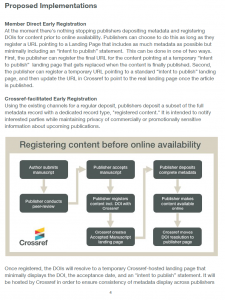
Crossref is proposing a process to support the registration of content—including DOIs and other metadata—prior to that content being made available, or published, online. We’ve drafted a paper providing background on the reasons we want to support this and highlighting the use cases. One of the main needs is in journal publishing to support registration of Accepted Manuscripts immediately on or shortly after acceptance, and dealing with press embargoes.
Proposal doc for community comment
We request community comment on the __proposed approach as outlined in this report.
Some examples of what we’d like to know:
Are you aware of the issues outlined in this proposal?
Are you aware of the funder and institutional requirements for authors to take action on acceptance of manuscripts for publication in journals?
Do you think the proposed solution and workflows are reasonable?
Are you likely to update your workflow to register content early?
If you are likely to update your workflow, how long do you estimate it will take?
Any other general comments, questions or feedback on anything raised in this document.
Please send comments, feedback and questions to me, Ginny, at feedback@crossref.org. The deadline for comments is February 4th. Thanks!
Related reading
Blog
Community responses to our proposal for early content registration