On behalf of the Nominating Committee, I’m pleased to share the slate of candidates for the 2026 board election. Every active member organisation is invited to submit a ballot to elect the incoming board class.
We’re providing a summary of the board’s July 2026 meeting. The July board meeting is our only in-person meeting. The board gathers for two days of strategic thinking and long-range planning, as well as conducting annual board business. This year, we focused on allocating surplus funds we have on hand to invest in a three-year project to redesign the content system. In a related discussion, we decided to lower content registration fees starting in 2027 because we’ve had a demonstrated history of generating surpluses, exceeding what we need to run Crossref. We also discussed the board structure, as part of our regular review of stakeholder governance. And we conducted annual board business, such as approving the audited financial statements and reviewed our risk register and mitigation plans.
The resolutions are available on the dedicated section of our website, which also lists the members of the Board and offers further information about our governance.
We also managed to squeeze in watching a World Cup game over dinner.
Starting today, funder names deposited in Crossref metadata without an identifier will be matched to ROR IDs, to support an open and connected Research Nexus. Funding information is an increasingly important part of the scholarly record. The improved matching strategy supports researchers, funders, institutions, and meta-researchers, who rely on that information to understand how research is supported and what outcomes that support produces.
Strengthening Scholarly Publishing in Africa is a collaborative webinar series bringing together ASSAf, Crossref, DOAJ, EIFL, and PKP to share practical guidance, resources, and approaches for strengthening the publishing ecosystem in the region. This series responds to the growing interest in open access, digital publishing, stronger editorial practices, and greater visibility of research publishing across Africa. Each partner organisation has long experience of building that capacity in the area of their expertise. In this series, we’re coming together to offer a more holistic learning experience to the community of African publishers, putting different aspects of the publishing process in their broader context.
We are a not-for-profit organisation, registered in the United States of America as a 501(c)6 (a “trade association”). We are sustained by a mixed-model with annual membership fees that are tiered according to organisational size and a one-time Content Registration fee for each record whose metadata is registered with us. We also provide both free metadata retrieval and paid-for options for access to and support for using this open metadata, along with other collective-access tools and services for our members only, such as Similarity Check.
Members can and do participate in many ways and contribute to our global network of linked scholarly content. We are governed by sixteen elected members that form our board, each serving three-year terms.
Revenue from Crossref’s annual dues and services sustains operations. Financial sustainability is a difficult task for open community infrastructures, and often a work in progress. Through decades of steady growth and careful management, Crossref has achieved financial health: a mixed model of membership- and activity-based revenue, rather than reliance on grant funding that can be withdrawn at short notice, and an operating reserve equal to one year’s expenses—a goal we reached in 2023.
Sustainability is a target to hit, not a surplus to hoard. Once our goals were met, we began returning the difference to members: reducing fees and removing back-year registration fees, while investing accumulated reserves in rebuilding our systems and supporting community initiatives. Infrastructure that asks to be relied upon in perpetuity should be able to show how it will still be here—and still be useful—in fifty years, not just five.
Crossref’s openness journey
Principles can be easy to box-tick; the test is what actions follow the promise. Becoming more open is not one decision but an accumulation of them: nudges over time that add up. Openness is also about accessibility and being available for all relevant stakeholders to participate in the infrastructure that we operate. Here are some of the openness choices Crossref has made over fifteen years, through four lenses.
Community
Preprints and peer review as first-class objects (2016)
Open metadata analyses through I4OC (2017–2024) and I4OA (2019–)
Moved Oracle to Postgres: open-source database management (2024)
Moved data and systems to the cloud and closed physical data centres (2025)
Nothing here was inevitable, and much of it was argued over at the time. That is rather the point: the record of what an open infrastructure organisation has done is the best evidence for what it will do.
And it adds up. Openness is the mechanism; a connected scholarly record that everyone can rely on is the impact. For where this goes next, see our strategy.
The Principles of Open Scholarly Infrastructure (POSI)
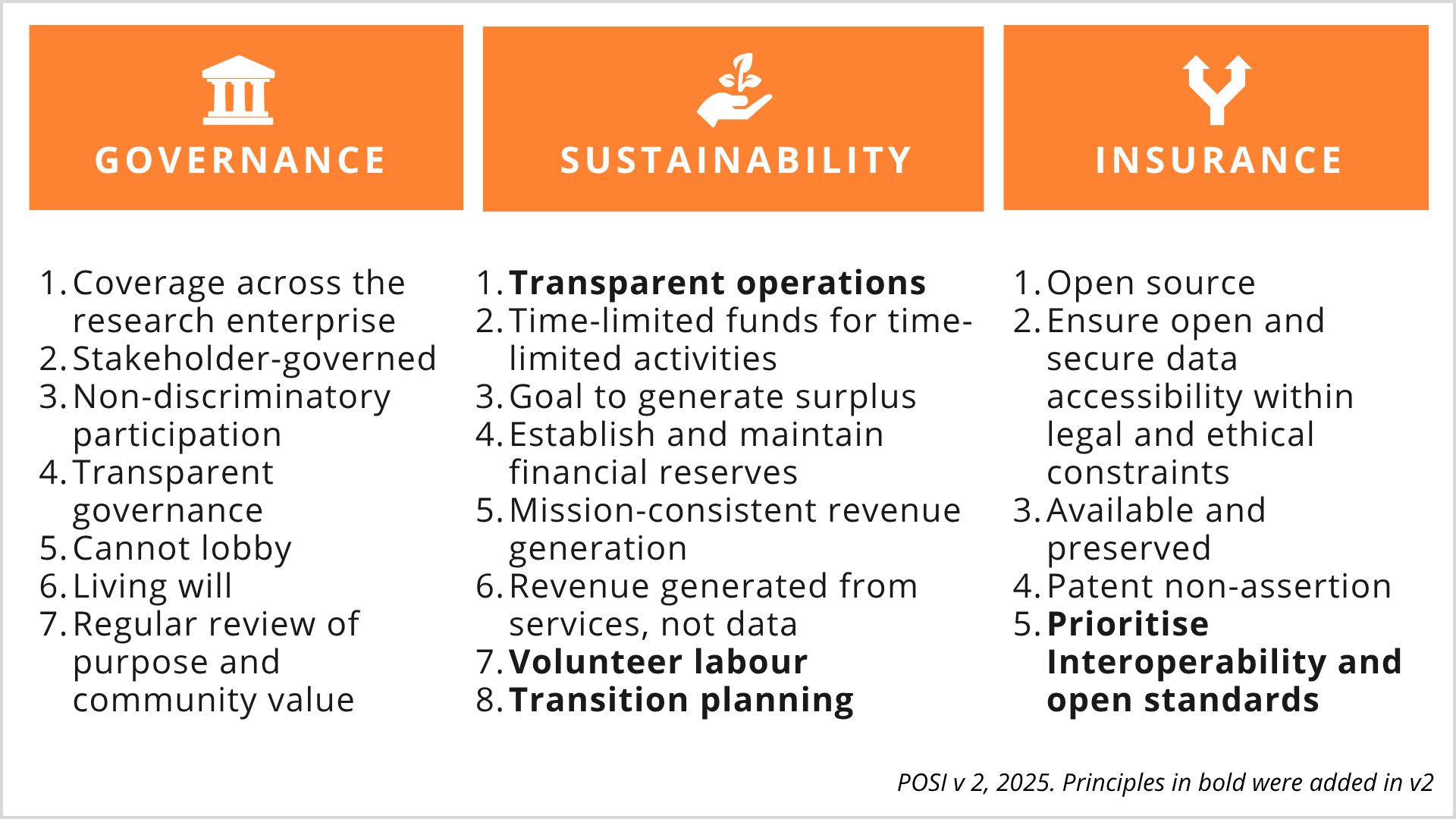
Crossref publishes biannual POSI self-assessments of our progress toward and reflections on meeting those principles. We also worked with the other POSI-adopting organisations to develop version 2 of the Principles, based on community input. For more on this, see the summary and recording of our March 2026 webinar with other adopters through the Barcelona Declaration.
POSI matters to Crossref because it converts good intentions into checkable commitments, across three pillars: how an organisation is governed, how it is funded, and what insures the community and its assets if it fails.
In July 2019 our board voted to approve the following set of principles to inform all future fee modelling and fee-related decisions. Crossref’s fees should:
Enable us to fulfil our mission to make research outputs easy to find, cite, link, assess, and reuse
Encourage best practice and discourage bad practice, as our policies and obligations advise
Be non-discriminatory, encouraging broad participation from organisations of all sizes and types
Support the long-term persistence of our services and infrastructure, so long as relevant and valuable to the community
Deliver value to our members
Be transparent and openly available, recommended by the Membership & Fees Committee and approved by the board
Be the same for all, not discounted or negotiated individually, to ensure fairness
Be independent of our members’ own business models
Not always be necessary (e.g., new record types are not usually separate services)
Be based on providing services not metadata
We are accredited in handling data
Crossref was awarded the SOC 2® accreditation most recently in 2025 after an independent assessment of our controls and procedures by the American Institute of CPA’s (AICPA).
The SOC 2® accreditation is awarded to service organisations that have passed standard trust services criteria relating to the security, availability, and processing integrity of systems used to process users’ data and the confidentiality and privacy of the information processed by these systems.
The AICPA’s assessment also reviewed our vendor management programs, internal corporate governance and risk management processes, and regulatory oversight.
We welcome public discourse about Crossref’s operations and sustainability. Please open a thread on our community forum if you have any questions or concerns to raise.
Page maintainer: Lucy Ofiesh Last updated: 2026-July-25